How to Make Money on Instagram in 2026 (9 Proven Streams)
How to make money on Instagram in 2026: brand deals, the newly relaunched native Reels affiliate program, Subscriptions, Shop, Gifts, UGC and 4 more monetization streams, with realistic earnings by follower tier and the exact first steps for nano creators.
15 min readInstagram Tips
On this page
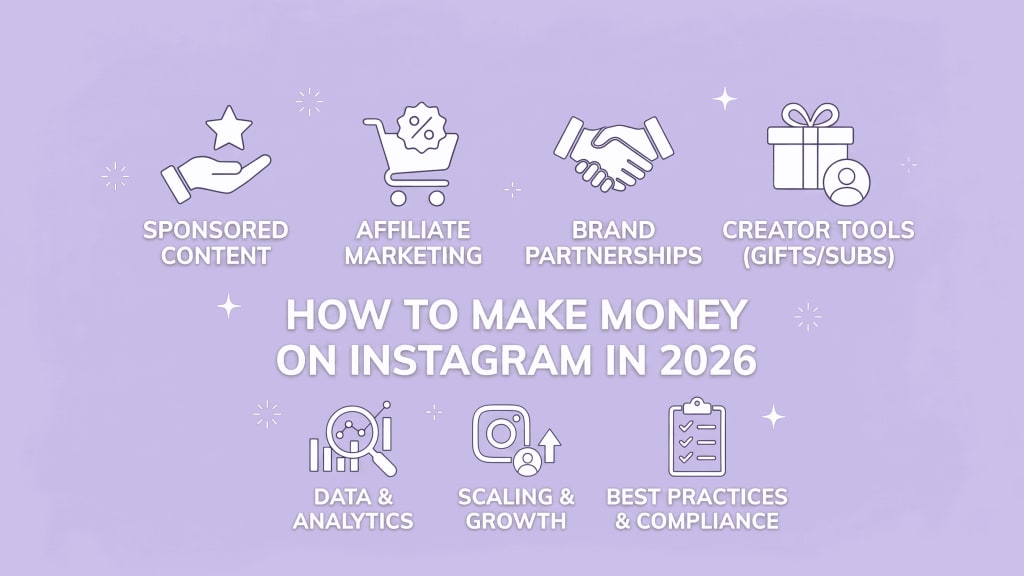
- Can You Really Make Money on Instagram?
- Instagram Monetization Requirements at a Glance
- 1. Sponsored Posts and Brand Partnerships
- Typical rates by follower tier (2026)
- How to land your first brand deal
- 2. Affiliate Marketing on Instagram
- 3. Sell Your Own Products or Services (Instagram Shop)
- Pros and cons
- 4. Instagram Subscriptions
- 5. Badges and Gifts (Live and Reels)
- 6. Creator Marketplace and Meta Verified
- 7. Reels Monetization and Ad Revenue Share
- 8. Sell Digital Products, Courses, or Coaching
- 9. Account Flipping and UGC Creation
- How Many Followers Do You Actually Need?
- How to Grow an Instagram Account That Actually Earns
- Mistakes That Kill Instagram Monetization
- Frequently Asked Questions
- How many followers do I need to make money on Instagram?
- How much do Instagram creators earn per post?
- Is the Instagram affiliate program active in 2026?
- How much do Instagram Reels pay per 1,000 views?
- What's the minimum for Instagram Subscriptions?
- Do I need a Business or Creator account to monetize?
- Can I make money on Instagram with 1,000 followers?
- What's Meta Verified and is it worth it?
- How much does Instagram take from my earnings?
- What's the fastest way to start earning on Instagram?
- Conclusion
For most creators asking how to make money on Instagram in 2026, the three income streams that actually pay the bills are (1) brand partnerships and sponsored posts, (2) affiliate commissions via the newly relaunched native Reels affiliate program, and (3) selling your own products, services, or digital offers to an engaged niche audience. Platform-native tools like Subscriptions, Badges, and Gifts matter at scale, but the big money on Instagram still comes from deals with brands and from selling directly to your audience. This guide covers every active monetization path, what it actually pays, and how small accounts can realistically start earning.
Can You Really Make Money on Instagram?
Short answer: yes, but the income curve is steeper than social media influencers tend to admit. Per 2026 data from Influencer Marketing Hub, Shopify, and Modash, nano-creators (1K–10K followers) typically earn $50–$500 per sponsored post, while most earn zero in their first three months because they haven't yet pitched a single brand.
Two honest caveats worth stating upfront:
Most accounts under 1,000 followers earn nothing from Instagram directly. Money starts to flow somewhere in the 1K–10K band for creators who actively monetize, and it scales nonlinearly from there.
Follower count is a weak predictor of income. A 5K account with 8% engagement in a commercial niche (finance, parenting, beauty) often outearns a 50K lifestyle account with 1% engagement.
With that honest frame, here's the full picture.
Instagram Monetization Requirements at a Glance
Method | Min. Followers | Other Requirements | Earning Potential |
|---|---|---|---|
Sponsored posts / brand deals | No platform gate (brands usually filter 5K+) | Professional account; strong engagement | $50–$500,000+ per post |
Native Affiliate (Reels product tags) | Rolling eligibility | Reels product-tagging enabled; 18+; eligible country | 5–20% commission on brand-paid program |
Instagram Shop | Business or Creator account | Eligible country; product-commerce approval | Margin on your own products |
Subscriptions | 10,000 | 18+; Professional account; eligible country | $0.99–$99.99/month per fan (Creator keeps 70%) |
Badges in Live | 10,000 | 18+; Professional account | $0.99–$4.99 per badge (Creator keeps 70%) |
Gifts on Reels (Stars) | 500 | 18+; Professional account; eligible country | Fan-funded, variable |
Creator Marketplace | No official minimum (brands filter 5K+) | Professional account; 18+; eligible country | Deal-dependent |
Reels ad revenue share | ~1,000 | Professional account; 18+; eligible country | $0.01–$0.12 per 1,000 views |
Meta Verified | No follower minimum | Paid subscription; ID verification | Not a revenue stream; protection + support |
Follower thresholds have eased meaningfully in 2026. Gifts on Reels dropped to 500 followers, and the native Reels affiliate program relaunched in March 2026 with per-region rollouts.
1. Sponsored Posts and Brand Partnerships
Brand deals are the single largest income source for most mid-tier Instagram creators. Pricing scales with followers, engagement, and niche.
Typical rates by follower tier (2026)
Nano (1K–10K): $50–$500 per feed post; $50–$300 per Reel; $15–$75 per Story
Micro (10K–100K): $250–$2,000 per post; Reels command 50–100% more than static feed
Mid-tier (100K–1M): $5,000–$25,000 per post
Macro (1M+): $25,000–$100,000+ per post
A rough industry formula is $10–$25 per 1,000 followers as a baseline for a feed post, adjusted up for engagement, usage rights, and niche. Instagram Stories typically price at 40–50% of feed-post rate because they disappear after 24 hours.
How to land your first brand deal
Pick a commercial niche. Finance, parenting, fitness, beauty, home, and travel attract the highest-paying brands. Pure lifestyle content is harder to monetize.
Build a lightweight media kit. A one-page PDF with your handle, follower count, average reach, engagement rate, audience demographics, and 3–5 past content samples. Tools like Canva make this a 30-minute job.
Pitch small brands directly. Don't wait for inbound. Identify 20 brands you already use and email their marketing or partnerships address with a short pitch and your media kit.
Tag brands organically first. Show you can talk about a product well before asking for money. Many first paid deals come from brands noticing unpaid tags.
Negotiate usage rights. If the brand wants to run your post as a paid ad (Spark Ads / Meta ads), charge a separate usage fee, typically 1.5–2× your base rate for a 30-day window.
2. Affiliate Marketing on Instagram
Instagram's native affiliate program relaunched in late March 2026 after being sunset in 2022. Creators can now tag products directly in Reels and earn commissions when viewers purchase. Meta has confirmed it's not taking a cut, your commission comes entirely from the brand's affiliate terms.
The native tagging feature is rolling out in phases through spring 2026, currently live in the US, Brazil, India, Indonesia, and Thailand, with expansion to all 22 Instagram commerce markets in progress.
Outside the native program, affiliate marketing on Instagram has never stopped working through third-party networks:
Amazon Associates (lowest barrier, anyone can join)
ShareASale, Impact, CJ Affiliate (brand-direct programs via networks)
LTK / ShopMy (creator-focused affiliate platforms for fashion, beauty, lifestyle)
Direct creator programs from brands you already promote
Link placement matters. Story link stickers convert better than bio-only links, and the native Reels product tags out-convert both when available. Disclosure (#ad / Paid Partnership tag) is mandatory under FTC rules and Instagram's Branded Content policy.
3. Sell Your Own Products or Services (Instagram Shop)
Instagram Shop lets eligible creators and businesses tag products directly in posts, Reels, and Stories. Unlike affiliate commissions, the margin here is entirely yours minus payment-processing fees.
Requirements:
Business or Creator account
Eligible country (full Shop functionality varies by region)
Product commerce approval through Meta Commerce Manager
Compliance with Meta's commerce policies
Typical product categories that do well via Instagram Shop: beauty, apparel, jewelry, home goods, wellness supplements, and print-on-demand. Services (coaching, consulting) don't list as Shop products but can be sold via Stories link stickers and DM funnels.
Pros and cons
Pros | Cons |
|---|---|
Highest margin of any monetization path | Requires your own inventory, fulfillment, or POD partner |
Direct customer relationship | Customer service burden is yours |
Products can be sold across Reels, Stories, and Lives | Needs real brand positioning and product-market fit |
Works at any follower count with product-market fit | Higher ops complexity than brand deals |
4. Instagram Subscriptions
Subscriptions let fans pay a monthly fee for exclusive Stories, Lives, Reels, posts, and a subscriber-only badge in the comments. You set the price between $0.99 and $99.99 per month.
Requirements (2026):
18+
10,000 followers
Professional (Creator or Business) account
Eligible country (US, UK, Canada, and expanding)
Compliance with Partner and Content Monetization Policies
The revenue split: creator keeps 70%, Meta and payment processors take 30% (Apple / Google also take app-store cuts on in-app purchases).
Subscriptions work best for creators with deep niche expertise, fitness coaches offering workout plans, finance educators sharing market analysis, artists showing process videos. Broad lifestyle content rarely converts to paid subscribers.
5. Badges and Gifts (Live and Reels)
Two fan-funding features, different thresholds.
Badges in Live. Viewers buy badges ($0.99 / $1.99 / $4.99) during your live streams to show support. Requires 10,000 followers, 18+, and a Professional account. Creator keeps 70%.
Gifts on Reels (Stars). Fans buy Stars and send them as virtual Gifts on your Reels, converting to cash payouts. Requires only 500 followers plus 18+ and an eligible country. This is one of the lowest-barrier monetization paths on the platform in 2026 and was explicitly designed to help smaller creators earn from viral Reels.
Neither feature will replace rent. They work best as supplemental income that rewards the creators your most loyal fans want to support directly.
6. Creator Marketplace and Meta Verified
Creator Marketplace is Meta's internal brand-to-creator matchmaking hub. No official follower minimum, but brands filter the marketplace for creators with at least 5K–10K followers and 3%+ engagement. Approval usually takes 24–72 hours after applying from a Professional account.
The Marketplace works best as an inbound channel, brands find you based on niche, audience demographics, and past content. It doesn't replace active outbound pitching but it does surface you to brands that already use the tool.
Meta Verified is a paid subscription ($11.99/month web, $14.99/month iOS/Android) that gives you a verified badge, impersonation protection, priority support, and certain creator tools. It's not a revenue stream, but on accounts that scale past 10K followers the support-access and impersonation-protection perks often pay for themselves. Don't subscribe at 500 followers expecting growth; the badge isn't a discovery lever.
7. Reels Monetization and Ad Revenue Share
Instagram's Reels ad revenue share program returned in limited form in late 2024 and expanded through 2025–2026. Eligible creators receive 55% of ad revenue generated from ads shown alongside their Reels, with Meta keeping 45%.
Typical per-1,000-view earnings in 2026:
General entertainment / lifestyle: $0.01–$0.05 per 1,000 views
High-CPM niches (finance, tech, health): $0.08–$0.12 per 1,000 views
Those numbers are modest. At 100K Reels views per month in a general niche, you're looking at $5–$20 from ad revenue share. It's pocket change relative to brand deals, but it's incremental. Meta also runs Seasonal Bonus Programs (holiday, spring, summer pushes) that invite eligible creators to earn bonus payouts for hitting specific content goals. Invitations are unpredictable, don't plan around them, but accept if offered.
Requirements: Professional account, 1,000+ followers, 18+, eligible country, compliance with Monetization Policies, and original content.
8. Sell Digital Products, Courses, or Coaching
For creators with genuine expertise, digital products typically outearn every other Instagram monetization path at the 5K–50K follower tier.
Common formats:
Ebooks and guides ($9–$49)
Notion / Airtable templates ($19–$99)
Online courses ($99–$999)
1:1 or group coaching ($200–$2,000+ per client)
Paid communities (Circle, Skool, Mighty Networks, $19–$99/month)
Paid newsletters (Substack, Beehiiv)
The math works because the margin is 90%+ after platform fees. A single $200 course sale equals 10–20 sponsored Stories at micro-creator rates. Promote via Stories link stickers, Reels CTAs, and DM funnels; use Linktree or a bio-link hub to collect offers in one place.
9. Account Flipping and UGC Creation
Two methods that get less coverage but are legitimately profitable for the right people, with caveats worth reading.
UGC (user-generated content) creation is arguably the best entry point for creators with small accounts who don't want to build a personal brand. You produce short videos for brands' own channels; they pay you as a contractor, not as an influencer. Rates run $200–$2,000 per video depending on complexity and usage rights. Follower count on your personal account is irrelevant, brands want content, not your audience. Platforms like Billo, Insense, and JoinBrands match UGC creators with briefs.
Account flipping, growing niche Instagram accounts (meme pages, interest pages, product pages) and selling them, is a gray zone. It works, and there are broker platforms for it, but Meta's policies prohibit account sales, which means any flip carries the risk of the account being permanently disabled after transfer. Treat as high-risk if you pursue it.
How Many Followers Do You Actually Need?
Realistic benchmarks based on what creators actually earn in each band:
Under 1,000: Focus on content quality and niche, not monetization. The only useful paid path here is UGC contracts, which don't depend on follower count.
1,000–10,000 (Nano): First brand deals become realistic. Gifts on Reels unlocks at 500. Ad revenue share is available. Expected income: $0–$500/month for most.
10,000–100,000 (Micro): Subscriptions, Badges, and Creator Marketplace unlock. Brand deals become regular. Realistic monthly income: $500–$5,000 across all streams for actively monetizing creators.
100,000–500,000 (Mid): Brand deals scale to $1K–$10K per post. Digital products at this tier can clear six figures a year in a commercial niche.
500,000+ (Macro/Mega): Full-time income. Brand deals alone routinely exceed $50K/month for top-tier creators.
How to Grow an Instagram Account That Actually Earns
Growth compounds when three things are aligned: a tightly scoped niche, a consistent content format, and signals that make the algorithm trust your account.
Post Reels as your primary format. Reels out-reach static feed posts 3–5× on most accounts and are the only format that meaningfully grows reach to non-followers.
Post 3–5 times per week consistently. Sporadic posting resets algorithmic trust. Consistent cadence matters more than daily volume.
Study your analytics weekly. Meta Business Suite shows reach, saves, shares, and watch-through. Double down on the formats that drive saves and shares; cut the rest.
Hook in the first 1–2 seconds. Watch-time on Reels is the single largest ranking signal.
Caption for saves. Captions that prompt bookmarking (checklists, step-by-step, quotes) get more saves, which weights heavily in Reels ranking.
Seed early social proof. Accounts below 1,000 followers often stall because Instagram's ranking systems treat low social proof as a quality signal. Services like Likes.io can help you cross that early follower threshold with authentic growth, which makes the algorithm more likely to surface your Reels to broader audiences and makes brands more likely to respond to cold pitches. It works best as one element of a broader growth plan, not on its own.
Mistakes That Kill Instagram Monetization
Avoid these six patterns, based on recurring issues we see with creators at Likes.io:
Switching to a Business account too early. Some creators report reach drops after switching. In practice, the reach difference is usually content quality, not account type, but if you're not yet monetizing actively, the Creator account works just as well and has better feature parity.
Buying cheap bot followers. Bots don't engage, tank your engagement rate (which is what brands actually pay for), and can trigger account action. Use reputable services with real followers.
Chasing trends outside your niche. Viral reach in a random niche grows followers who'll never convert to customers or buy from brands that pay you.
No bio CTA and no link. Every professional account should have a clear CTA in the bio plus a bio link hub. Missing this leaves 100% of funnel income on the table.
Undercharging on brand deals. Nano creators routinely accept $50 for deliverables worth $300+. Check tier benchmarks before you quote.
No disclosure on sponsored content. Missing #ad or Paid Partnership tags violates FTC rules and Instagram's Branded Content policy. A single violation rarely triggers action; a pattern can.
Frequently Asked Questions
How many followers do I need to make money on Instagram?
You can start earning at 500 followers via Gifts on Reels and at any follower count via UGC contracts. Brand deals usually open around 1,000–5,000 followers with strong engagement. Subscriptions and Badges require 10,000 followers.
How much do Instagram creators earn per post?
Nano (1K–10K): $50–$500 per post. Micro (10K–100K): $250–$2,000. Mid-tier (100K–1M): $5,000–$25,000. Macro (1M+): $25,000–$100,000+. Rates depend heavily on engagement rate, niche, and whether usage rights are included.
Is the Instagram affiliate program active in 2026?
Yes. Meta relaunched the native Reels affiliate program in late March 2026, rolling out first in the US, Brazil, India, Indonesia, and Thailand. Creators can tag products in Reels and earn commissions. Meta is not taking a cut; commissions come entirely from the brand's affiliate terms.
How much do Instagram Reels pay per 1,000 views?
Reels ad revenue share pays roughly $0.01–$0.05 per 1,000 views in general niches, and $0.08–$0.12 in high-CPM verticals like finance and tech. Creators receive 55% of ad revenue; Meta keeps 45%.
What's the minimum for Instagram Subscriptions?
You need 10,000 followers, a Professional account, 18+, and residency in an eligible country. Creators set monthly prices between $0.99 and $99.99 and keep 70% of subscription revenue.
Do I need a Business or Creator account to monetize?
You need a Professional account (either Creator or Business) for nearly every monetization tool, including Creator Marketplace, Subscriptions, Badges, Gifts, Reels ad revenue share, and native affiliate tagging. Personal accounts can still do informal sponsored posts but lose access to built-in tools.
Can I make money on Instagram with 1,000 followers?
Yes. At 1,000 followers plus 18+ and a Professional account, Reels ad revenue share unlocks. Gifts on Reels was already available at 500. Nano-tier brand deals ($50–$500 per post) also become realistic, especially in commercial niches.
What's Meta Verified and is it worth it?
Meta Verified is a paid subscription ($11.99/month web) offering a verified badge, impersonation protection, and priority support. It's not a revenue stream. It's most worthwhile at 10K+ followers, where impersonation risk and brand-deal professionalism matter.
How much does Instagram take from my earnings?
Instagram keeps 30% of Subscriptions, Badges, Gifts, and Tips (creators keep 70%). On ad revenue share for Reels, creators get 55%, Meta keeps 45%. Native affiliate commissions have no Meta cut; your share comes from the brand's program.
What's the fastest way to start earning on Instagram?
UGC contracts if you don't want a public brand, starts at any follower count, pays $200–$2,000 per video. Otherwise, focus on Reels, pitch 10 small brands per week once you hit 1K followers, and add affiliate links via the native program or a creator network.
Conclusion
Learning how to make money on Instagram in 2026 is less about hitting a magic follower number and more about matching the right monetization stack to your niche, your audience, and your time. Brand deals pay the most per post. Your own products pay the most per customer. Subscriptions, Badges, and Gifts reward creators with deep fan loyalty. The new native Reels affiliate program closes one of the largest gaps Instagram had versus TikTok Shop.
Your first concrete step: switch to a Professional account (if you haven't), pick your single most commercial niche topic, and post three Reels this week optimized for a 1–2 second hook and a save-worthy caption. That's the foundation every monetization tool on this list compounds on top of.

Georgia Austin is a senior SEO copywriter, content marketing strategist, and Forbes 30 Under 30 nominee (2026, Marketing & Advertising). Originally from the UK and now based in the U.S., she has 10+ years of experience working with brands like Nike, Under Armour, Tommy Hilfiger, Siemens, and American Express. Georgia is the Founder & CEO of Wordbrew, a content creation platform for businesses worldwide. She's earned over $3M in revenue as a top 1% Fiverr Pro seller with 18,000+ completed projects and an 8,500+ five-star review track record.