Spotify Monthly Listeners: What the Number Actually Counts
Spotify monthly listeners are the separate people who streamed you in the last 28 days, not plays and not a calendar month. Here is the mechanism: the rolling window, active versus programmed listeners, why the number falls without anything going wrong, and what a good count actually looks like.
8 min readSocial Media Marketing
On this page
- Spotify's definition, word for word
- It counts people, not plays
- The 28-day window rolls, it does not reset
- Active listeners and programmed listeners
- Monthly listeners vs followers vs streams
- Why the number only moves once a day
- What counts as a good number
- Legitimate ways to grow it
- What about buying monthly listeners?
- Frequently asked questions about Spotify monthly listeners
- How does Spotify count monthly listeners?
- Is Spotify monthly listeners based on a calendar month?
- Why did my Spotify monthly listeners suddenly drop?
- Do you get paid for Spotify monthly listeners?
- How much money is 1,000 monthly listeners on Spotify?
- Is 1,000 monthly listeners on Spotify a lot?
- Is Spotify monthly listeners accurate?
- What is the 30 second rule on Spotify?
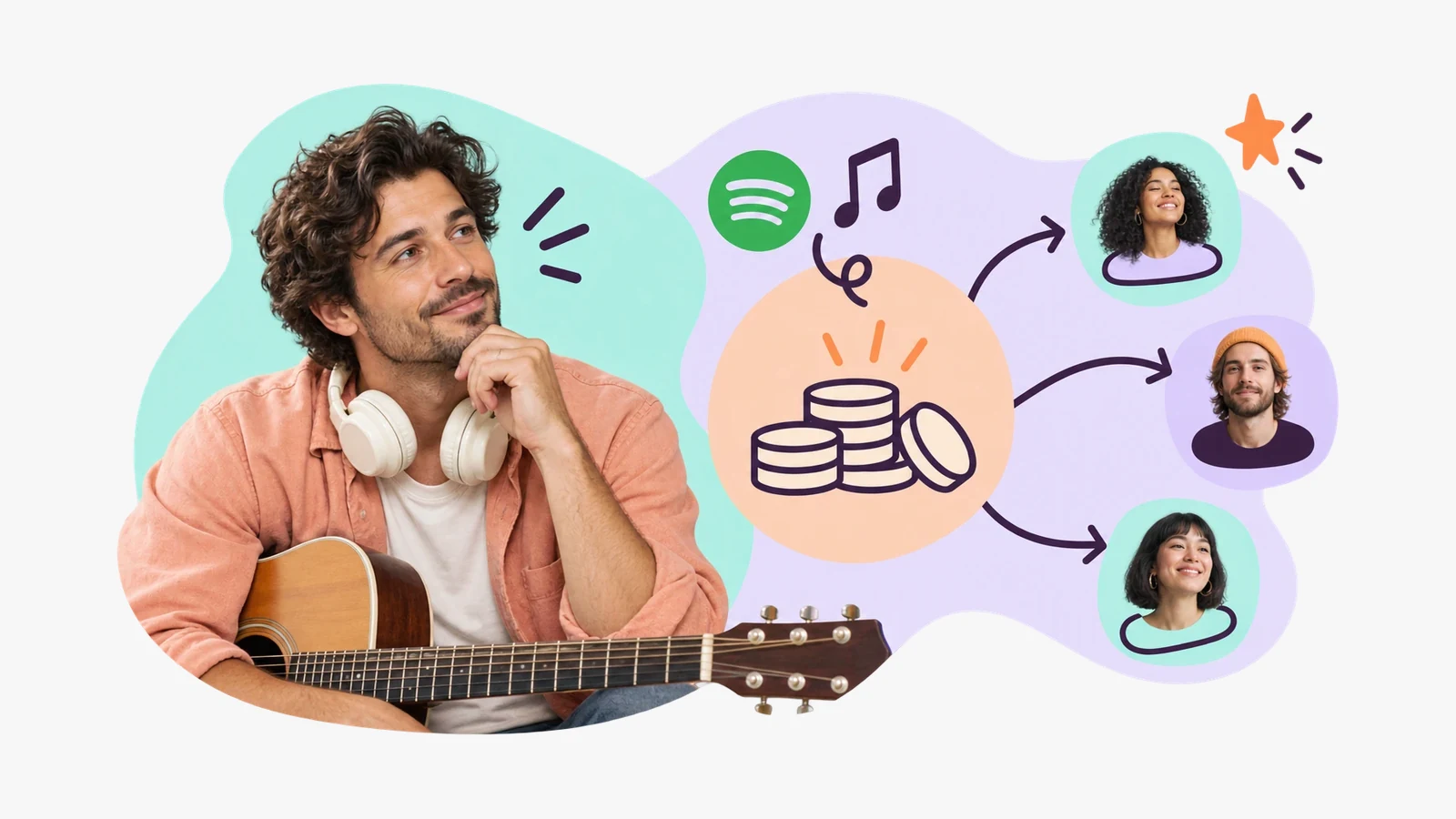
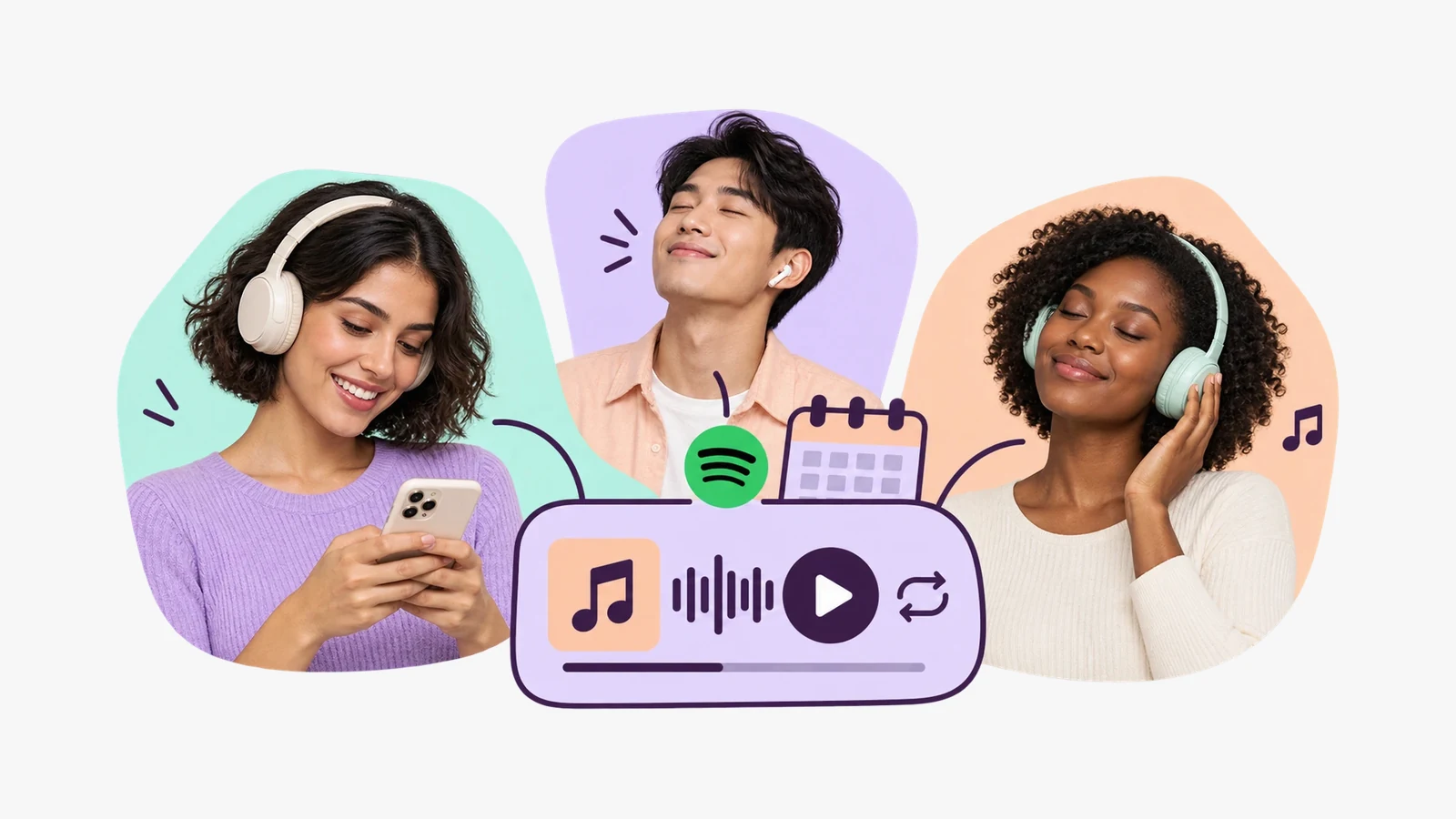
Monthly listeners is the number at the top of your Spotify artist profile, and it is the one most artists misread. It is not plays, it is not a calendar month, and it is not a total that only goes up. It counts how many separate people listened to you in the last 28 days, recalculated once a day, so it can fall with nothing having gone wrong.
What follows is the mechanism, with every Spotify claim linked to a Spotify-owned page.
Spotify's definition, word for word
"Your monthly listeners are your total listeners in the last 28 days - including both active and programmed listeners."
That is from Audience segments on Spotify. Three parts of it carry the meaning: listeners (people, not plays), 28 days (not a month), and the last 28 days (a window that moves every day).
It counts people, not plays
Someone who plays your track once and someone who plays it fifty times in the same window both count as one monthly listener. That is why the figure can sit flat while your streams climb: a small, devoted audience produces many streams and few new listeners.
A play only registers once it lasts: Spotify counts a stream "when the song or video is played for at least 30 seconds". Put Spotify's two definitions together and a five-second skip is not a stream at all, so it is not the kind of play that puts someone into your listener count.
The 28-day window rolls, it does not reset
Explainers often describe the number as "reloading" every 28 days. Nothing reloads. The window slides: each day the oldest day drops off the back of the calculation and the newest joins the front.
A worked example, with invented numbers chosen only to show the shape. Say 1,000 different people listened on release day and around 100 on an ordinary day. For 28 days that release day sits inside the window and your profile looks strong. On day 29 it falls out, and if those 1,000 did not come back they leave the count with it, dropping your monthly listeners by roughly that much overnight. Nothing was removed and no penalty was applied; the window moved past the spike. The count falls whenever the day leaving the back of the window held more unique listeners than the day joining the front.
Active listeners and programmed listeners
Spotify's own definition names two kinds of listener inside that total, and the difference between them is where a lot of confusing movement comes from.
Monthly active listeners are "a subset of your monthly listeners who intentionally streamed your music in the last 28 days from active sources, indicating they'll keep streaming more in future."
Programmed listeners have "only streamed your music from programmed sources," which Spotify lists as editorial playlists, playlists made by other listeners, sets from AI DJ, and personalised playlists.
A placement on someone else's playlist therefore fills your count with people who never chose you. When it ends the arrivals stop, and 28 days later the last of them leave the window. A large count with a small active share is reach, not an audience.
Monthly listeners vs followers vs streams
| Metric | What it counts | Window |
|---|---|---|
| Monthly listeners | Separate people who streamed you | Last 28 days, rolling daily |
| Monthly active listeners | The subset who chose you deliberately | Last 28 days, rolling daily |
| Followers | People who pressed Follow | Until they unfollow |
| Streams | Plays of 30 seconds or more, every time | Each time it happens |
Followers are the closest thing to a standing audience; monthly listeners are a snapshot of a moving 28 days. The two numbers rarely match, because programmed sources deliver people who never had to follow.
Why the number only moves once a day
Spotify for Artists is not a live dashboard. Spotify states that "Your stats update once a day at approximately 3 PM EST / 8 PM UTC", and that stats "are recorded in Coordinated Universal Time (UTC). You can't change the time zone." Release at midnight and see nothing by lunchtime, and you are looking at yesterday, not a bug. Your statistical day is a UTC day, so late-evening listening in the Americas lands on the next date.
What counts as a good number
Spotify publishes no benchmark for this, so every threshold quoted online is somebody's estimate rather than a platform standard. Genre and stage dominate anyway: an ambient producer, a regional rap artist and a covers act with identical counts sit in different commercial positions. Read the shape of your number, not its size:
- The trend across windows. A number that steps up and holds is not the same as one that spikes and returns.
- Your active share. The proportion who are also active listeners is the nearest thing to an audience-quality reading Spotify gives.
- Your floor, not your peak. Where the count settles 28 days after a spike is nearer your real audience size.
Legitimate ways to grow it
The count only rewards unique people inside a 28-day window, so growth has one mechanism: get more different people to press play, hold past 30 seconds, and come back.
- Release more often. Every release date gives new people a reason to arrive and old listeners a reason to re-enter the window.
- Turn programmed listeners into active ones. A follow or a save lets a playlist listener find you again without an algorithm's help.
- Spread arrivals out. One enormous day helps for 28 days then leaves in one piece; steady arrivals decay gently.
- Stop chasing repeat plays from the same people. They add streams. They cannot add listeners.
What about buying monthly listeners?
We sell this, so read the section knowing that. Anything delivered into a rolling 28-day window leaves that window, so purchased monthly listeners decay the same way a playlist spike does. Our Spotify monthly listeners service carries no refill guarantee, because a metric that expires by design cannot honestly be topped back up under one. It is a temporary display figure, not audience growth, and not something Spotify pays on.
Spotify's position belongs here too. Its User Guidelines prohibit "artificially increasing play counts or follow counts... including by... providing or accepting any form of compensation (financial or otherwise)." Spotify says third-party services that advertise streams in return for payment "violate our terms & conditions, and using them could result in your music being removed from Spotify," and Loud & Clear states that "when we detect any artificial streams, those streams do not earn royalties." How we weigh that is in our platform risk disclosure. Decide with the whole picture.
Frequently asked questions about Spotify monthly listeners
How does Spotify count monthly listeners?
It counts how many separate people streamed your music in the last 28 days, active and programmed listeners together. People, not plays: one person is one listener however often they press play. The figure updates once a day.
Is Spotify monthly listeners based on a calendar month?
No. Spotify's wording is "the last 28 days," a window that rolls forward daily rather than a month resetting on the 1st, so the number can change on any date.
Why did my Spotify monthly listeners suddenly drop?
Check the mechanism before assuming a penalty: a strong day rolls out of the back of the 28-day window and nothing replaces it. A release or playlist placement brings a wave of one-time listeners, and they leave the count 28 days later. Playlist removals show up on the same delay.
Do you get paid for Spotify monthly listeners?
No, monthly listeners are not a payment unit. Spotify states it "does not pay artist royalties according to a per-play or per-stream rate", paying rightsholders instead on streamshare, their share of total streams in a market that month. Since April 2024 a track must also reach at least 1,000 streams in the previous 12 months to enter the recorded music royalty pool.
How much money is 1,000 monthly listeners on Spotify?
There is no figure, because monthly listeners are not what Spotify pays on. A thousand people who each played one track once earn very differently from a thousand who played an album daily, and Spotify says payments "might vary according to... the agreements they have with labels or distributors."
Is 1,000 monthly listeners on Spotify a lot?
It depends on genre and stage, and Spotify publishes no benchmark to measure it against. A thousand people who keep coming back beats a thousand who arrived from one playlist and left. Compare against your own previous windows, not a threshold.
Is Spotify monthly listeners accurate?
It accurately counts what it measures: unique listeners in the trailing 28 days, refreshed daily and recorded in UTC. It misleads only when people assume otherwise: it is not a fanbase, a lifetime total or an earnings figure. Spotify also states artificial streams do not count toward public stream numbers.
What is the 30 second rule on Spotify?
Spotify counts a stream "when the song or video is played for at least 30 seconds." A play cut short before that is not a stream at all, so it is not the kind of play that adds someone to your listener count.

Maddy Osman is a content marketing expert with 16+ years of experience in SEO, social media strategy, and digital content. She's the founder of The Blogsmith content agency, bestselling author of "Writing for Humans and Robots," and has been named a Top 100 Content Marketer by Semrush and BuzzSumo. Her work has been featured in Moz, Semrush, Search Engine Journal, and Newsweek.